
%20(1).png)
Florida Property Taxes Could Change in 2027: What Amendment 3 Could Mean for Homeowners
Property taxes are almost always part of the conversation when buying or owning a home in Florida, but this year there is another reason for homeowners and prospective buyers to understand how Florida's property-tax system could change.
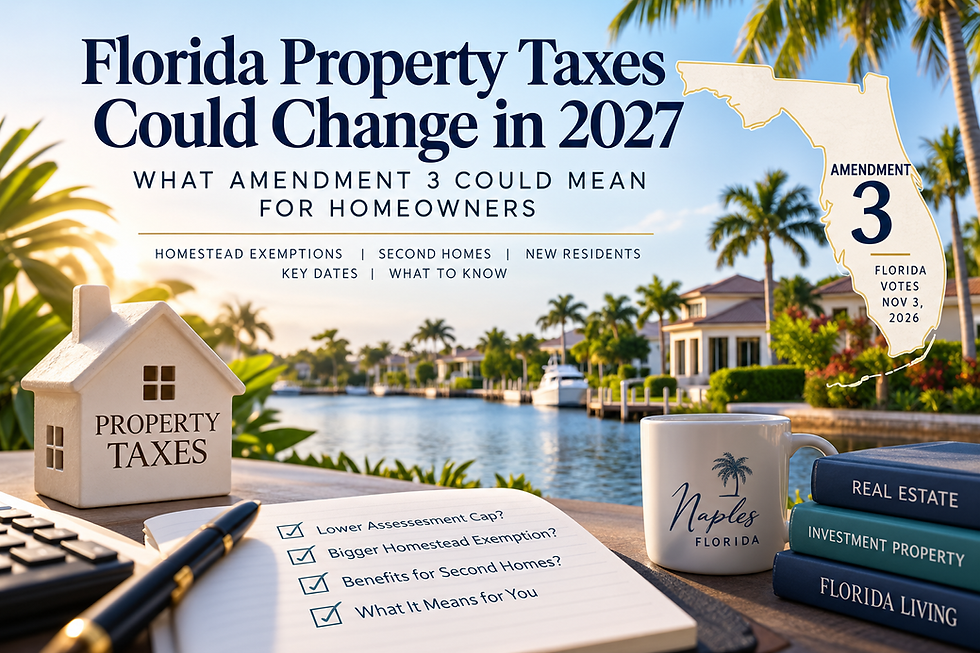
Florida voters will decide on Amendment 3 in the November 3, 2026 general election. Officially titled “Increased Homestead Exemption; Lower Cap on Increases in Non-Homestead Property Assessments,” the proposed constitutional amendment would make several changes to Florida's property-tax system if approved.
Some of the discussion surrounding Amendment 3 has focused on the December 31, 2026 residency date. While that date is important, the proposal is considerably broader. It includes changes that could affect current Florida homestead owners, people who become Florida residents in the future, second-home owners and owners of other non-homestead property.
Because property taxes can already be confusing, I thought it would be helpful to step away from the headlines and explain what is actually being proposed, what has to happen for the amendment to become law, when we will know the outcome and what the different provisions could mean for property owners.
What Is Florida Amendment 3?
Amendment 3 proposes several changes to Florida's Constitution related to property taxation. One of the primary changes is an increase in the homestead exemption that applies to property taxes other than school-district taxes.
For qualifying homeowners covered by the increased exemption, the exemption would increase to as much as $150,000 beginning January 1, 2027, and then to $250,000 beginning January 1, 2028. Beginning in 2029, the exemption amount would be adjusted annually for positive inflation.
The proposal also addresses non-homestead property. Florida currently limits annual increases in the assessed value of qualifying non-homestead property to 10% for applicable non-school levies. Amendment 3 would reduce that annual assessment-growth cap from 10% to 5%. The amendment contains additional provisions concerning how counties and municipalities may use property-tax revenue and establishes a framework through which additional exemptions could potentially be adopted in the future. Because the proposal addresses several different parts of Florida's property-tax system, its effect would depend in part on the type of property and the owner's homestead and residency status.
What Has to Happen for Amendment 3 to Pass?
Amendment 3 is a proposed amendment to the Florida Constitution, so approval requires more than a simple majority. Under the Florida Constitution, a proposed constitutional amendment generally must receive approval from at least 60% of the voters voting on the measure.
Florida voters will consider Amendment 3 during the general election on November 3, 2026. If at least 60% of those voting on the amendment approve it, the proposal will become part of the Florida Constitution. If it receives less than 60%, the amendment will not take effect. The amendment specifies an effective date of January 1, 2027. Therefore, none of the proposed changes discussed here should be considered current law. They are contingent upon voter approval in November.
When Will We Know Whether It Passed?
Votes will be reported beginning on election night, November 3, 2026, so there should be an indication of whether the amendment reached the required 60% threshold as election results are reported. Election-night results are not the same as final certified results. Florida election results proceed through the state's canvassing and certification process. For property owners and prospective buyers, however, the important point is that the outcome should be determined before the amendment's proposed January 1, 2027 effective date.
Until the election occurs and the results are finalized, homeowners and buyers should treat Amendment 3 as a proposal rather than an existing property-tax benefit.
Could Amendment 3 Still Change?
The wording surrounding Amendment 3 has already gone through a legal review process. The original ballot title and summary were challenged in court, and the language presented to voters was subsequently rewritten. The Florida Department of State currently lists the measure as active under the title “Increased Homestead Exemption; Lower Cap on Increases in Non-Homestead Property Assessments.”
It is important to distinguish between the ballot summary and the underlying constitutional amendment. The ballot summary is the condensed description voters see when casting their ballots. Changes to that description do not necessarily change the underlying constitutional text being proposed.
If voters approve Amendment 3, some implementation details would still require additional action. The amendment directs the Florida Legislature to establish certain procedures through general law, including a uniform process through which counties and municipalities could increase homestead exemptions for their respective levies.
Therefore, voter approval would establish the constitutional framework, but subsequent legislation, administrative guidance and local-government decisions could affect how certain portions of that framework are implemented.
What Would Amendment 3 Mean for Current Florida Homestead Owners?
For qualifying homeowners who fall within the amendment's provisions for existing Florida residents, the homestead exemption applicable to non-school property taxes would increase to as much as $150,000 beginning in 2027 and $250,000 beginning in 2028. Beginning in 2029, the amount would be adjusted annually for positive inflation.
The distinction between school and non-school taxes is important. A Florida property-tax bill can include levies from several taxing authorities. The expanded exemption proposed by Amendment 3 would apply to non-school levies and would not exempt the same amount from school-district property taxes.
As a result, a $250,000 homestead exemption should not be interpreted as $250,000 in tax savings. It represents an amount of assessed value that would be exempt from applicable non-school property taxes. The actual dollar difference on an individual property-tax bill would depend on the property's assessed value, applicable exemptions, taxing jurisdiction and millage rates.
How Would the Increased Homestead Exemption Actually Work?
An exemption reduces the portion of a property's assessed value that is subject to a particular tax. It does not represent a direct dollar-for-dollar reduction in the tax bill. For example, if an additional $200,000 of a home's assessed value became exempt from certain non-school property taxes, the homeowner would not save $200,000. Instead, the applicable non-school millage rates would no longer be applied to that $200,000 of assessed value.
This distinction is important because the actual dollar effect could vary among homeowners. Properties located in different taxing jurisdictions can be subject to different millage rates, and individual properties may have different assessed values, exemptions and assessment histories.
What About Florida's Save Our Homes Benefit?
Florida's existing Save Our Homes provision is separate from the homestead exemption. For qualifying homesteaded property, Save Our Homes generally limits annual increases in assessed value to the lesser of 3% or the applicable change in the Consumer Price Index.
That cap applies to the property's assessed value rather than directly limiting the homeowner's total tax bill. The increased homestead exemption proposed under Amendment 3 would operate separately by increasing the amount of assessed value exempt from applicable non-school taxation.
Another important consideration is what happens when a property changes ownership. When a homesteaded property is sold or conveyed to a new owner, its assessed value can be reset based on market value. If the new owner subsequently qualifies for homestead, the assessment-cap process begins again for that owner.
This is one reason buyers should be cautious about using a seller's current property-tax bill to estimate their own future taxes. A seller who has owned and homesteaded a property for many years may have an assessed value that is considerably different from what a new owner's assessment will be after the property changes hands.
Why Does December 31, 2026 Matter?
One of the more important provisions of Amendment 3 involves the date on which a person maintains permanent Florida residency. The amendment distinguishes between people who are Florida residents by December 31, 2026 and those who establish Florida residency on or after January 1, 2027.
Under the proposal, qualifying people who are Florida residents by December 31, 2026 and establish homestead may be eligible for the increased exemption according to the 2027 and 2028 schedule. Those who become Florida residents beginning January 1, 2027 would initially be subject to a different exemption schedule.
However, buying a Florida home and establishing Florida permanent residency are not necessarily the same thing. Florida law considers a number of factors when determining permanent residency, and qualification for a homestead exemption has its own legal requirements. Under current Florida law, a person generally must have the required legal or beneficial interest in the property and make the property his or her permanent residence as of January 1 to qualify for that year's homestead exemption.
Therefore, Amendment 3 should not be interpreted simply as saying that anyone who closes on a Florida property before December 31 automatically receives the larger exemption. Ownership, permanent residency and homestead qualification are related concepts, but they are not interchangeable. Anyone considering changing residency or the timing of a real estate transaction specifically because of the proposed amendment should consult the appropriate property appraiser and qualified tax or legal professionals regarding his or her individual circumstances.
What Would Happen to People Who Become Florida Residents in 2027 or Later?
Amendment 3 establishes a different schedule for people who are not Florida residents on December 31, 2026. Under the proposal, a person who subsequently establishes Florida permanent residency and qualifies for homestead would initially receive the existing homestead exemption, with the exemption amount adjusted as provided by the amendment.
Beginning with the fifth year of the exemption, that homeowner could become eligible for the increased exemption available to qualifying residents who were Florida residents by the end of 2026. The official ballot summary qualifies this provision with the phrase “to the extent permitted by the U.S. Constitution.”
Beginning in 2030, the amendment also creates a mechanism allowing a county or municipality, by a two-thirds vote of its governing body, to determine that a critical local need warrants reducing the five-year requirement.
If the amendment passes, this is an area where subsequent legislation and implementation guidance will be important, particularly for people establishing Florida residency after 2026.
What Would Amendment 3 Mean for Second Homes and Investment Properties?
Amendment 3 is not limited to homesteaded property. The proposal would also change the annual assessment-growth cap that applies to certain non-homestead properties. Under current Florida rules, qualifying non-homestead properties are generally subject to a 10% cap on annual assessment increases, excluding the School Board portion of property taxes. Amendment 3 would reduce that cap to 5%.
This provision could apply to properties such as second homes, vacation properties, rental properties and other non-homesteaded real estate. It is particularly relevant to understand in Southwest Florida, where properties are purchased for a variety of purposes and not every owner establishes the property as a Florida homestead.
Just as with Save Our Homes, an assessment cap is not the same as a cap on the total tax bill. The proposed 5% provision would limit increases in the applicable assessed value. It would not guarantee that a property's total tax bill could never increase by more than 5%, because millage rates and other components of the tax bill can also change.
What Could Amendment 3 Mean for Someone Buying a Naples Home?
The effect would depend largely on how the buyer intends to use the property. Someone purchasing a Naples home as a primary residence could potentially be affected by the expanded homestead provisions, including the rules involving when Florida permanent residency is established.
Someone purchasing a second home would generally not qualify that property for a homestead exemption simply by owning it. However, the proposed reduction in the non-homestead assessment-growth cap could apply to qualifying non-homestead property. Similarly, someone purchasing a rental or other investment property could be affected by the non-homestead assessment provisions rather than the expanded homestead exemption.
Regardless of whether Amendment 3 passes, buyers should continue to understand that the current owner's property-tax bill is not necessarily a reliable estimate of their own future tax bill. Ownership changes, reassessment, homestead status, Save Our Homes history, portability, exemptions and millage rates can all affect the eventual amount.
Could Local Governments Increase Homestead Exemptions Further?
Amendment 3 also requires the Legislature to establish a uniform procedure through which counties and municipalities could increase the amount of assessed value exempt from their respective property-tax levies, potentially up to the property's full assessed value. The amendment also provides a mechanism through which special districts could increase exemptions, subject to referendum approval.
This does not mean that Collier County, the City of Naples or another local government would automatically eliminate applicable property taxes on homesteaded property if Amendment 3 passes. Instead, the constitutional amendment would establish authority and a framework under which additional exemptions could potentially be considered through procedures established by law. The extent to which those provisions would ultimately be used would depend on future legislative and local-government actions.
What Would the Amendment Mean for Local Property-Tax Revenue?
The proposed changes affect both taxpayers and the tax base available to certain local taxing authorities. Increasing the amount of assessed value exempt from non-school property taxes would reduce the amount of taxable assessed value to which those levies apply. Similarly, reducing the annual assessment-growth cap for non-homestead property could affect the growth of taxable assessed value over time.
Amendment 3 also contains provisions governing how counties and municipalities may use property-tax revenues. The official ballot summary states that property taxes would be used for specified categories including public safety, education and schools, infrastructure, natural resources, bond debt service, employee retirement benefits, and operations and administration, while providing for certain other expenditures to be approved by local officials unless prohibited by general law.
The actual fiscal effect on a particular county or municipality would depend on factors including its property-tax base, property values, millage rates, exemptions, budget decisions and how the amendment is ultimately implemented. Those local fiscal effects cannot be determined solely by looking at the exemption amount available to an individual homeowner.
What Happens Between Now and November?
For now, Amendment 3 does not change anyone's property-tax bill. It remains a proposed constitutional amendment that Florida voters will consider on November 3, 2026. At least 60% of voters voting on the amendment must approve it for it to become part of the Florida Constitution. If approved, the amendment specifies that it would take effect January 1, 2027. The increased homestead exemption would reach $250,000 in 2028 for qualifying homeowners covered by that provision, with positive inflation adjustments beginning in 2029.
If the amendment passes, additional legislation and administrative guidance may be necessary to implement certain provisions. Decisions by individual counties, municipalities and special districts could also become relevant where the amendment provides for local action.
What We Know and What We Don't Know Yet
What we know today is the constitutional framework being presented to voters. We know the proposed exemption amounts, the proposed reduction in the non-homestead assessment cap, the residency distinction, the 60% approval requirement and the proposed effective date.
What we do not yet know is whether voters will approve the amendment. We also do not yet know every implementation detail that could follow approval, what subsequent legislation may provide where the amendment calls for general law, or whether individual local governments would eventually use the additional authority contemplated by the amendment.
Those distinctions are important. Some provisions are contained directly in the proposed constitutional amendment, while others depend on actions that would occur only after voter approval.
The Bottom Line for Naples Homeowners and Buyers
Florida property taxes involve much more than applying a tax rate to a home's purchase price. Market value, assessed value, homestead status, Save Our Homes, portability, exemptions, ownership changes, taxing jurisdictions and millage rates can all influence what a property owner ultimately pays.
If Amendment 3 passes, it would make several changes to that system. It would increase the homestead exemption applicable to non-school property taxes for qualifying homeowners, establish different treatment for certain people becoming Florida residents beginning in 2027, reduce the annual assessment-growth cap for qualifying non-homestead properties from 10% to 5%, and establish additional provisions concerning local exemptions and the use of property-tax revenues.
For people considering a move to Florida, December 31, 2026 is a date worth understanding because the amendment distinguishes between residents based on whether they maintain Florida residency by the end of 2026. That should not, however, be interpreted as a blanket recommendation to purchase a property or establish residency before that date. Individual circumstances and qualification requirements vary.
For now, the most important fact is that Amendment 3 has not yet been approved by Florida voters. The November 3 election will determine whether the proposed constitutional changes move forward. If the amendment passes, the next step will be understanding the legislation, administrative guidance and local decisions that follow and how those changes apply to individual Florida property owners.
Important Disclaimer
This article is provided for general informational and educational purposes only and reflects information available as of September 17, 2026. Amendment 3 is a proposed amendment to the Florida Constitution and has not been approved by Florida voters as of the date of publication. The proposal, its implementation, related legislation, court proceedings, administrative guidance and local-government actions may change or develop over time.
Nothing in this article is intended as legal, tax, accounting or financial advice, nor should it be relied upon to determine whether an individual qualifies for Florida residency, a homestead exemption, a property-tax benefit or any other exemption. Property-tax treatment depends on individual circumstances and applicable law. Buyers, sellers and property owners should consult the appropriate county property appraiser and qualified legal, tax or financial professionals regarding their specific circumstances.
About Renee Hahn | Your Naples Expert
Renee Hahn, CNE, CLHMS, Million Dollar GUILD™
Your Naples Expert
Alfred Robbins Realty Group
Serving buyers and sellers throughout Naples, Marco Island, Bonita Springs, Estero and Southwest Florida.
Whether you're considering a move to Naples, purchasing a second home or investment property, or preparing to sell, I'm always happy to help you understand the real estate side of the equation and connect you with the appropriate professionals when questions extend into tax, legal or financial matters.
Good Enough Just Isn't.


Comments